
Winter in Galway can be harsh, and for homeowners, one of the biggest risks is frozen and burst pipes. A single burst pipe can cause thousands of euros in water damage, ruin flooring, and damage electrical systems. In this comprehensive guide, we'll cover the science of why pipes burst and the essential steps you must take to protect your Galway home during the freezing Irish months.
Table of Contents
- 1. The Physics: Why Do Pipes Actually Burst?
- 2. Insulation: More Than Just Foam Sleeves
- 3. Maintaining Heat During Cold Snaps
- 4. The Stopcock: Your First Line of Defense
- 5. The Danger of Dripping Taps
- 6. Protecting External Fixtures & Outbuildings
- 7. Step-by-Step: What to Do If a Pipe Bursts
- 8. High-Tech Leak Detection in Galway
- 9. Frequently Asked Questions (FAQ)
1. The Physics: Why Do Pipes Actually Burst?
Many people assume that it's the expansion of ice itself that cracks the pipe. While ice does expand as it freezes, the actual cause of a burst is often the massive spike in water pressure *between* the ice blockage and the closed faucet. When water freezes inside a pipe, it expands by about 9%, creating a solid plug. As the ice grows, it pushes the remaining liquid water towards the tap. In a closed system, this pressure can reach thousands of pounds per square inch—far exceeding the burst rating of copper or plastic (PEX) piping.
In Galway, we often see this happen during "rapid thaw" cycles. If a pipe has been frozen for days and then suddenly warms up, the structural integrity of the weakened pipe is tested. This is why it's critical to identify frozen sections early before the pressure builds to a catastrophic point.
2. Insulation: More Than Just Foam Sleeves
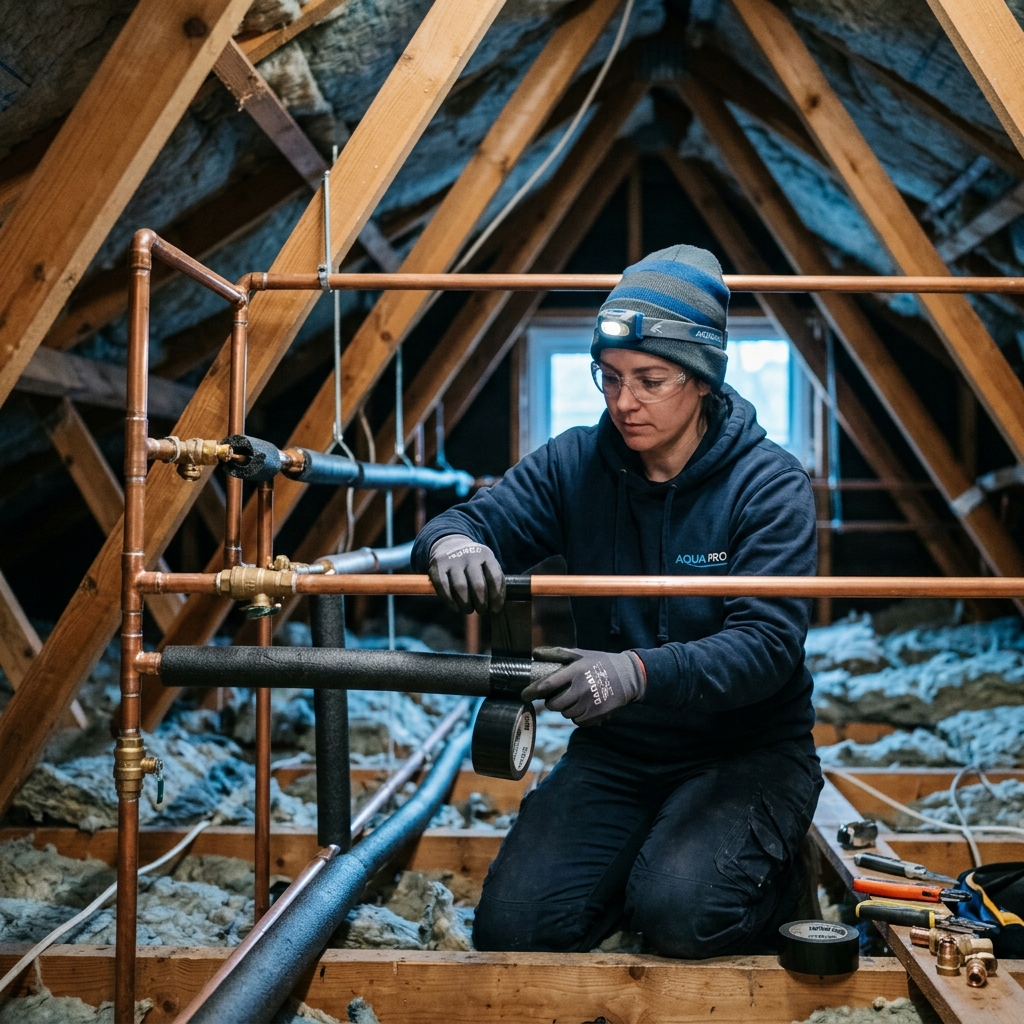
The most effective way to prevent freezing is high-quality insulation. However, simply throwing a foam sleeve over a pipe isn't always enough. You must focus on pipes in unheated areas such as attics, crawl spaces, and garages. For Galway homes, where dampness is a constant factor, we recommend using moisture-resistant closed-cell foam lagging.
Pay special attention to the elbows and joints—these are the most common points of failure where heat escapes. Additionally, ensure there are no gaps in the insulation. Even a one-inch gap in a freezing attic can allow enough cold air to create an ice bridge. If you're planning a larger renovation, you might consider how updated plumbing layouts can move pipes away from exterior walls entirely. For more on modern plumbing layouts, check our bathroom renovation guide.
3. Maintaining Heat During Cold Snaps
One of the most common mistakes is turning the heating off when the house is empty. If you're heading away for a winter holiday, or if a property is currently vacant in an area like Salthill or Oranmore, you must keep the heating on at a "frost protection" level. We recommend setting your thermostat to at least 12-15°C.
Modern boilers often have a built-in frost protection mode that automatically kicks in if the water temperature in the heat exchanger drops too low. If your boiler is over 15 years old, it may lack this feature, making it much more vulnerable to winter damage. You can read more about upgrading to a modern boiler here. Another tip: open the cabinet doors under sinks on exterior walls to allow warm house air to circulate around the pipes.
4. The Stopcock: Your First Line of Defense
If a pipe does burst, every second counts. A standard residential pipe can leak hundreds of liters of water in just an hour, causing irreversible damage to ceilings and electronics. Make sure everyone in your home knows exactly where the main water shut-off valve (stopcock) is located. In many Irish homes, this is located under the kitchen sink or in the hallway.
We recommend testing your stopcock twice a year. Over time, these valves can seize due to mineral build-up (limescale). If you can't turn it by hand, don't force it—contact a plumber to have it serviced or replaced with a modern lever-style valve which is much easier to operate in an emergency.
5. The Danger of Dripping Taps
A tiny drip might seem harmless, but in freezing temperatures, that slow trickle of water can freeze within the waste pipe or the supply line itself. Over time, the ice layers build up until they form a complete blockage. This is particularly dangerous for modern condensing boilers, where the "condensate pipe" (which exits the house) can freeze, causing the boiler to shut down entirely during the coldest night of the year.
Ensuring all taps are fully tightened and washers are in good condition is a simple but effective winter precaution. If you notice a tap that won't stop dripping, it's a minor repair that can prevent a major winter headache.
6. Protecting External Fixtures & Outbuildings
External garden taps and pipes leading to garages or sheds are the most vulnerable to the Irish frost. If possible, turn off the internal isolation valve to your outside tap and drain any remaining water from the line by opening the external tap until it stops flowing.
Fitting an inexpensive thermal jacket or 'tap cozy' over the external fixture provides a vital extra layer of protection. For properties with outdoor livestock troughs or detached workshops, consider installing 'heat tape'—an electric cable that wraps around the pipe and gently warms it when temperatures drop below freezing.
7. Step-by-Step: What to Do If a Pipe Bursts
If the worst happens and you discover a leak, follow this checklist immediately to minimize damage:
- Turn off the Stopcock: Shut off the main water supply immediately.
- Drain the System: Open all cold taps to drain the remaining water from the pipes. Flush the toilets.
- Turn off the Heating: Switch off your boiler and immersion heater.
- Collect the Water: Use buckets or towels to catch any dripping water to protect your flooring.
- Call an Emergency Plumber: Contact B Collins Plumbing at +353 87 971 0559 for a 24/7 priority response.
- Document the Damage: Take photos of the burst and the resulting water damage for your insurance claim.
8. High-Tech Leak Detection in Galway
Sometimes, a burst pipe isn't visible. You might notice a drop in boiler pressure, a damp patch on a wall, or a sudden increase in your water bill. Conventional plumbing might require tearing up floors to find the source. However, at B Collins Plumbing, we use **Precision Leak Detection** technology.
This includes acoustic sensors that "listen" for the sound of pressurized water escaping and thermal imaging cameras that "see" the heat signature of leaking hot water through solid concrete floors. These non-invasive methods save you time, money, and unnecessary structural damage to your property.
9. Frequently Asked Questions (FAQ)
Most standard Irish home insurance policies cover the damage caused by a burst pipe (escape of water). However, some may not cover the cost of the repair to the pipe itself. Always check your policy for "Trace and Access" cover, which pays for the cost of finding the leak.
Never use a blowtorch or open flame! This can damage the pipe or cause a fire. Instead, use a hairdryer on a low setting, a heat pad, or towels soaked in hot water. Always start thawing from the end nearest the tap and work your way back.
Yes. While plastic piping is more flexible and can expand more than copper, it can still burst if the pressure build-up from ice expansion exceeds its limits. Proper insulation is just as important for modern plastic systems.
During a cold snap, demand is extremely high. B Collins Plumbing operates a 24/7 emergency service, and we prioritize urgent bursts. We typically aim to be on-site within 60-90 minutes for emergencies in Galway City and surrounding areas.